30-Year Lease vs Buying Property in Koh Phangan: Which Is Better for Foreign Buyers?
If you are considering buying property in Koh Phangan, one of the most important decisions is whether to purchase a property with a 30-year leasehold structure or pursue a form of freehold ownership where legally available.
For many international buyers, this can be confusing. A property may be advertised as a “villa for sale”, but that does not necessarily mean you are buying the land. In Thailand, the distinction between owning the building, owning a condominium unit, and holding a long-term right to use land is extremely important.
So, 30-Year Lease vs Buying Property in Koh Phangan — which is better?
The short answer is:
A 30-year registered lease is often the most practical structure for a foreigner buying a villa or house on Koh Phangan, while freehold ownership is generally preferable where a foreign buyer can legally obtain it, such as an eligible condominium unit within the foreign ownership quota.
The right choice depends on your intended length of stay, budget, investment objectives, resale plans and how important permanent ownership is to you.
This guide explains the differences in detail, including the legal structure, costs, resale potential, inheritance, renewals, investment considerations and what foreign buyers should check before committing to property on Koh Phangan.

30-Year Lease vs Buying Property in Koh Phangan: The Quick Answer
For someone searching specifically for 30-Year Lease vs Buying Property in Koh Phangan, the fundamental difference is this:
| 30-Year Leasehold | Freehold Ownership | |
|---|---|---|
| What you own | A registered lease/right to use the property or land for a fixed term | The property interest itself |
| Typical foreign villa structure | Yes | Generally no land ownership |
| Maximum standard registered lease term | 30 years | No lease expiry |
| Renewal | May be agreed, but future renewal is not the same as already owning another registered 30-year term | Not applicable |
| Foreign ownership of land | No | Generally no |
| Foreign ownership of eligible condominium | Not applicable | Yes, subject to Thai law and the 49% foreign quota |
| Resale | Possible, subject to the lease terms and remaining term | Generally simpler |
| Long-term security | Good when properly structured and registered | Stronger because there is no lease expiry |
| Best suited to | Villas, homes and lifestyle purchases | Eligible condominium purchases and qualifying ownership structures |
| Main risk | Lease eventually expires | Availability, foreign quota and purchase price |
| Key consideration | Remaining lease term and renewal provisions | Title, quota and legal eligibility |
The biggest mistake is to treat a 30-year lease as equivalent to buying land outright.
It isn’t.
A lease gives you contractual and registered rights for a defined period. Freehold ownership gives you an ownership interest that does not simply expire after 30 years.
Why the Difference Matters on Koh Phangan
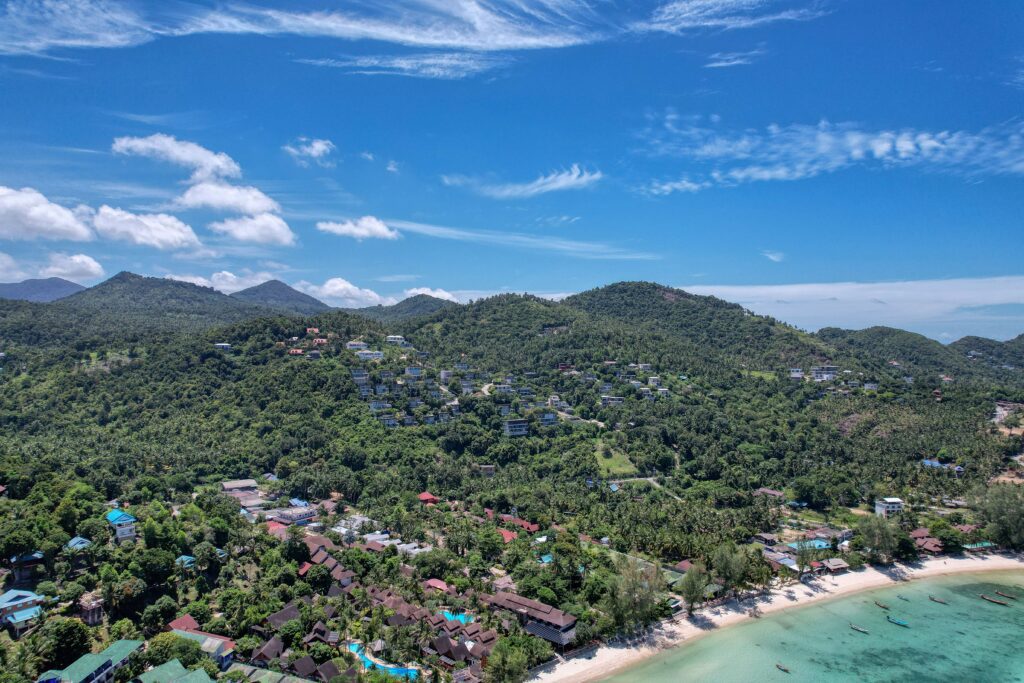
Koh Phangan has become increasingly attractive to international buyers looking for villas, pool homes, development opportunities and long-term residences.
However, Thailand has restrictions on foreign ownership of land.
The Thai government explains that foreigners generally cannot own land directly, although there are limited statutory exceptions. Foreign buyers can, however, own qualifying condominium units under the Condominium Act, subject to the foreign ownership quota.
This is why the phrase “buying property in Koh Phangan” needs to be treated carefully.
A foreigner looking at a Koh Phangan villa may actually be considering:
- A 30-year lease of the land
- Ownership of the building separately from the land
- A condominium unit with freehold ownership
- A leasehold condominium
- Another legally structured property interest
These are very different arrangements.
For most foreign buyers interested in a standalone villa, the question therefore isn’t simply:
“Should I buy or lease?”
It is:
“Should I purchase a property through a registered leasehold structure, or should I look for a property that I can legally own freehold?”

What Is a 30-Year Lease in Thailand?
A standard long-term land lease in Thailand can be registered for a maximum of 30 years under the general rules applicable to immovable property leases.
The Department of Lands states that leases of immovable property exceeding three years need to be registered in order to have legal effect for the full agreed period.
This makes registration at the Land Office one of the most important parts of a Koh Phangan leasehold purchase.
A properly structured lease can give the buyer a legally recognised right to occupy and use the property for the registered term.
For example, imagine a villa is offered for ฿8 million on a 30-year lease.
You are not purchasing the underlying land for ฿8 million.
Instead, the transaction may involve:
- a 30-year registered lease over the land;
- ownership of the villa/building being separately established where appropriate;
- contractual rights covering use of the property;
- provisions dealing with transfer, inheritance, maintenance and other obligations.
This structure can be perfectly legitimate and can be particularly attractive to foreigners who want to live on Koh Phangan without attempting to own Thai land directly.

Is a 30-Year Lease the Same as Buying Property?
No.
This is perhaps the most important answer in the entire guide.
A 30-year lease gives you a right to use the property for the agreed period. It does not give you permanent ownership of the underlying land.
When the registered lease expires, your leasehold right expires unless a new legally valid arrangement is made.
This is why buyers should be extremely careful with marketing language such as:
“30 + 30 + 30 years = 90 years guaranteed ownership.”
A future renewal is not the same thing as having a 90-year registered property right from day one.
The Thai government’s property information describes long-term leases as having a maximum 30-year term and notes that they can be renewed with the consent of the lessor.
The practical point for a buyer is therefore simple:
Treat the first 30 years as the legally registered lease term. Treat future renewals as something that needs to be carefully examined in the contract and legally structured, rather than automatically assuming that three consecutive 30-year periods are guaranteed.
This distinction is particularly important when comparing different Koh Phangan property developments.

What Does “Buying Property” Mean for a Foreigner in Koh Phangan?
The word “buying” can mean different things.
Buying a Freehold Condominium
A foreigner can generally own a qualifying condominium unit freehold in Thailand, subject to the requirements of the Condominium Act and the project’s foreign ownership quota.
The foreign ownership limit is generally 49% of the total condominium space in the project.
A freehold condominium is therefore fundamentally different from a 30-year villa lease.
The buyer obtains registered ownership of the condominium unit rather than merely a time-limited lease.
However, Koh Phangan has fewer conventional condominium developments than larger Thai destinations such as Bangkok, Phuket or Koh Samui.
That means freehold condominium options may be considerably more limited depending on the location and the development.
Buying a Villa
Buying a villa requires more careful analysis.
A foreigner generally cannot simply purchase the land underneath a standalone villa in their own name.
Instead, a common legal structure is for the foreign buyer to hold a registered lease over the land while separately establishing ownership of the building where the legal structure allows it.
The Department of Lands provides official guidance confirming that leases exceeding three years should be registered in order to receive the full legal protection of the agreed term.
This is why a villa advertised to foreigners as “leasehold ownership” should not automatically be viewed as inferior or suspicious.
Leasehold can be a legitimate and practical way for an international buyer to acquire long-term use of a Koh Phangan property.
The quality of the legal structure is what matters.

30-Year Lease vs Freehold: Which Is Better?
There isn’t one answer for every buyer.
The better option depends on what you are actually trying to achieve.
A 30-Year Lease May Be Better If You:
- want a villa rather than a condominium;
- plan to live on Koh Phangan for 10–30 years;
- want to avoid complicated ownership structures;
- want a lower entry price than comparable freehold property;
- are primarily buying for lifestyle rather than permanent wealth transfer;
- are comfortable with a fixed-term property right;
- want access to properties that may not be available freehold to foreigners.
For someone planning to spend the next 15 or 20 years living on Koh Phangan, a 30-year lease can provide a substantial period of security.
Freehold May Be Better If You:
- want permanent ownership;
- want the simplest long-term ownership structure available to you;
- intend to pass the property to your children;
- want to minimise concerns about lease expiry;
- are buying primarily as a long-term capital asset;
- want the strongest possible resale proposition;
- can find an eligible freehold condominium within the foreign quota.
A freehold condominium can be particularly attractive to buyers who place a high value on permanence.

The 30-Year Time Horizon Is Longer Than It Sounds
One reason a 30-year lease can make sense is that many buyers aren’t actually planning 50 or 60 years into the future.
Suppose you are 50 years old and intend to spend the next 20 years living on Koh Phangan.
A 30-year lease extends considerably beyond your initial lifestyle horizon.
Likewise, someone purchasing a holiday villa at 45 may have no intention of retaining the property until the end of the lease.
In that situation, the key question becomes:
What will the property be worth when you eventually want to sell or transfer the remaining lease?
This is where the remaining lease term becomes extremely important.
A newly registered 30-year lease and a lease with only eight years remaining are not economically equivalent.

Lease Term and Resale Value
One of the biggest differences between a leasehold and freehold property is resale.
A freehold property does not have a lease clock counting down.
A leasehold property does.
If you purchase a villa with 30 years remaining and sell it after 10 years, the buyer may be purchasing a property with approximately 20 years remaining, subject to the precise legal structure and transaction arrangements.
That can influence the resale price.
The shorter the remaining lease, the more important the lease terms become.
For this reason, buyers should consider lease duration as an asset that depreciates over time.
This doesn’t mean a leasehold villa cannot appreciate in value.
Koh Phangan land values, construction costs, tourism demand, rental income and the desirability of individual locations can all influence property values.
But the lease term is an additional factor that doesn’t exist in the same way with freehold ownership.

What Happens When the 30 Years Are Up?
This is one of the most common questions about buying property on Koh Phangan.
At the end of the registered 30-year term, the lease itself reaches its contractual end.
What happens next depends on the legal agreements, the parties involved and the law applicable at that time.
A new lease may potentially be negotiated and registered if the parties agree and the legal requirements are satisfied.
However, a buyer should not assume that a future renewal is identical to already owning a second or third 30-year term.
This is why the renewal clause in the original contract deserves careful legal review.
A professional Thai property lawyer should examine:
- the initial lease;
- renewal provisions;
- rights of assignment;
- rights of inheritance;
- rights to transfer the lease;
- building ownership;
- superficies arrangements where applicable;
- obligations of the landowner;
- termination provisions;
- default provisions;
- development or management obligations.
The Department of Lands continues to publish guidance concerning lease registration and extensions, highlighting the importance of properly registering lease rights and any subsequent changes.

Should You Buy a 30-Year Leasehold Property on Koh Phangan?
For many buyers, yes.
But you should buy the leasehold because the specific property and legal structure make sense — not simply because someone tells you that “30 + 30 + 30 equals 90 years.”
A good leasehold property should be evaluated on its own merits.
Consider:
1. Location
Location remains one of the biggest factors in Koh Phangan property.
A well-located villa in areas such as Haad Yao, Sri Thanu, Hin Kong, Haad Salad, Chaloklum, Haad Rin, Baan Tai or other desirable areas may have stronger long-term appeal than an inferior property with a supposedly better ownership structure.
2. Land title
The underlying land title needs to be examined.
A lawyer should verify the title and confirm that the person or entity granting the lease has the legal authority to do so.
3. Remaining lease term
A brand-new 30-year lease is very different from purchasing a resale property with only 12 or 15 years remaining.
4. Registration
For a lease exceeding three years, registration at the Land Office is critical to obtaining protection for the full agreed term.
5. Building ownership
If you are purchasing a villa, determine exactly who owns the building and what documents establish that ownership.
6. Transfer rights
Can you sell or assign the lease?
If so, under what conditions?
7. Inheritance
What happens to the property if the leaseholder dies?
This should be addressed before purchase rather than after the event.
8. Renewal provisions
Understand exactly what is promised and what is not.
9. Rental rights
If you intend to rent the property, confirm that the proposed rental activity is legally permitted and that any required licences, management arrangements and local regulations are satisfied.
10. Exit strategy
Ask yourself:
“Who will buy this property from me in 10 or 15 years?”
Thinking about resale before buying is one of the best ways to evaluate a leasehold investment.

The Financial Comparison: Leasehold vs Freehold
The purchase price isn’t the only number that matters.
A proper comparison should include the total cost of ownership.
For a leasehold property, consider:
- purchase price;
- lease registration costs;
- legal fees;
- due diligence;
- construction costs if applicable;
- furniture;
- maintenance;
- insurance;
- property management;
- land and building-related taxes where applicable;
- utilities;
- sinking funds or development fees;
- rental management costs;
- future transfer costs.
For freehold property, consider similar costs plus the acquisition and transfer costs associated with the freehold title.
The cheapest headline purchase price isn’t necessarily the cheapest property to own.

Example: 30-Year Lease vs Freehold
Imagine two properties on Koh Phangan.
Property A — Leasehold Villa
Purchase price: ฿7,000,000
Registered lease: 30 years
Villa: private pool, two bedrooms and good location.
Property B — Freehold Condominium
Purchase price: ฿7,000,000
Freehold condominium title.
At first glance, both cost the same.
But they are not equivalent assets.
Property A provides a 30-year leasehold interest, potentially combined with ownership of the building depending on the structure.
Property B provides registered ownership of the condominium unit, assuming the buyer qualifies and the foreign quota is available.
If both properties are expected to appreciate, the freehold condominium has the advantage of not having a lease expiration.
However, Property A may offer:
- more land;
- a private garden;
- a private pool;
- greater privacy;
- a standalone villa;
- more space;
- better suitability for a family;
- potentially stronger holiday-rental appeal.
This illustrates why the best property isn’t necessarily the property with the strongest legal tenure.
You have to compare the whole asset.

30-Year Lease vs Buying Property in Koh Phangan for Investment
If your primary objective is investment, the calculation becomes more complicated.
A leasehold villa can potentially generate rental income, but investors should consider the effect of the remaining lease term on future resale.
For example, a property purchased with 30 years remaining may look attractive to today’s buyer.
After 15 years, however, the remaining lease term may become a much more important consideration for the next buyer.
This means investors should look beyond:
Purchase price + rental income = return
and consider:
Purchase price + acquisition costs + operating costs + rental income + capital appreciation + remaining lease term + eventual resale value.
A property that generates excellent rental income but becomes difficult to resell later may have a very different investment profile from a freehold property.

What About “30 + 30 + 30 Years”?
This is one of the most searched questions when researching Thai leasehold property.
You will often see developments marketed with language such as:
30 + 30 + 30 years
or
90-year leasehold.
The important thing is to investigate exactly what this means legally.
A standard land lease has a maximum registered term of 30 years under the general rules. The Thai government’s own property guidance describes long-term leases as having a maximum 30-year term and potential renewal subject to the lessor’s consent.
Therefore, don’t evaluate a property solely because a sales brochure says “90 years.”
Ask:
- What is registered today?
- What exactly is contractual?
- Who controls the land?
- Who must agree to renewal?
- How is renewal documented?
- When can renewal occur?
- What happens if the landowner changes?
- What happens if the property is sold?
- What happens if the lessor dies?
- Can the lease be assigned?
- Can the lease be inherited?
- What happens if the developer fails?
- What happens if the development company changes?
These questions are far more important than the headline “90 years.”

Is a 30-Year Lease Safe on Koh Phangan?
A properly structured and registered lease can be a legitimate way for a foreigner to secure long-term use of property in Thailand.
The important word is properly.
A buyer should not rely solely on a developer, seller or estate agent to explain the legal structure.
Independent legal due diligence is strongly recommended.
The Department of Lands confirms that long leases need to be registered to obtain the full legal effect of the agreed term, and its current public guidance continues to address registration of leasehold rights.
Before transferring a substantial amount of money, your lawyer should verify the underlying title and transaction documents.

What About Using a Thai Company to Buy the Land?
Foreign buyers are sometimes told that the easiest solution is to establish a Thai company and purchase the land through it.
This area requires considerable caution.
A Thai company must be genuine and comply with Thai corporate and foreign ownership laws. Using nominee shareholders simply to circumvent restrictions on foreign land ownership is not a structure that should be treated as a routine alternative to leasehold.
For most lifestyle buyers, a properly structured leasehold arrangement can be significantly more straightforward than attempting to create an artificial ownership structure.
The objective should be to create a structure that is legally defensible, transparent and appropriate to the buyer’s actual circumstances.

30-Year Lease vs Buying Property in Koh Phangan for Retirement
For someone planning to retire on Koh Phangan, the decision often comes down to priorities.
If your primary goal is:
“I want a beautiful home where I can live for the next 20–30 years.”
A 30-year lease may be perfectly reasonable.
If your primary goal is:
“I want to own an asset permanently and leave it to my children.”
Freehold ownership, where legally available, may be considerably more attractive.
The distinction is especially important for estate planning.
A buyer should discuss the proposed structure with a qualified Thai lawyer before purchase if inheritance is an important objective.

30-Year Lease vs Freehold Condominium on Koh Phangan
For a foreign buyer, the most straightforward freehold comparison is often a condominium.
Under Thai law, qualifying foreigners can own condominium units, subject to the project’s foreign ownership quota, generally limited to 49% of the total condominium area.
This creates an interesting choice:
Freehold Condo
Advantages
- Permanent ownership
- No 30-year expiry
- Easier long-term inheritance planning
- Stronger tenure
- Potentially easier resale
Disadvantages
- Limited supply on Koh Phangan
- Foreign quota restrictions
- No private land
- Usually less privacy than a villa
- May not provide the same lifestyle experience
30-Year Leasehold Villa
Advantages
- Private home
- Garden and pool potential
- More land and privacy
- Wide range of villa locations
- Often attractive for lifestyle buyers
- Can be structured legally for foreign purchasers
Disadvantages
- Fixed lease term
- Renewal needs careful consideration
- Remaining lease affects resale
- Does not provide permanent ownership of the land
- Requires stronger legal due diligence

Which Is Better for Koh Phangan: Leasehold or Freehold?
For the typical foreign buyer wanting a private villa on Koh Phangan, a properly structured 30-year leasehold arrangement is often the practical option.
For a buyer who can find an appropriate freehold condominium and places a high value on permanent ownership, freehold may be preferable.
For an investor, the decision should be based on the numbers rather than simply the word “freehold” or “leasehold.”
And for someone planning to build a long-term home, lifestyle considerations can be just as important as legal tenure.

The Biggest Mistakes Foreign Buyers Make
Mistake 1: Assuming “villa for sale” means land ownership
It doesn’t necessarily.
Always establish exactly what you are purchasing.
Mistake 2: Assuming 30 + 30 + 30 is automatically guaranteed
Future renewals need to be legally examined.
Mistake 3: Not checking the land title
The underlying title should be independently verified.
Mistake 4: Paying a large deposit before legal due diligence
Have the documents reviewed before making an irreversible commitment.
Mistake 5: Ignoring the remaining lease term
A 30-year lease with 29 years remaining and one with 10 years remaining are completely different propositions.
Mistake 6: Focusing only on purchase price
Calculate the complete ownership and exit costs.
Mistake 7: Not thinking about resale
Ask who the future buyer will be.
Mistake 8: Assuming a developer’s contract is sufficient
An independent lawyer should review the transaction from the buyer’s perspective.

What Should You Check Before Buying a Leasehold Property on Koh Phangan?
Before signing, a foreign buyer should consider having a qualified Thai property lawyer independently verify:
- Chanote or other underlying land title
- Identity and legal ownership of the landowner
- Authority of the person granting the lease
- Registered lease term
- Lease registration requirements
- Building ownership
- Superficies or other relevant rights where applicable
- Transfer and assignment provisions
- Inheritance provisions
- Renewal provisions
- Termination clauses
- Default provisions
- Mortgages or encumbrances on the land
- Existing leases or rights affecting the property
- Planning and construction permissions
- Building permits
- Access rights
- Road access
- Utility rights
- Water and electricity arrangements
- Property management obligations
- Rental arrangements
- Taxes and fees
- Developer obligations
- Any restrictions recorded against the property
This may seem excessive when you are excited about finding your dream villa.
It isn’t.
The more expensive the property, the more important proper due diligence becomes.

So, Should You Lease or Buy Property in Koh Phangan?
The best answer depends on what you mean by “buy.”
If you are a foreigner looking for a standalone villa, you will generally need to think in terms of land rights and building ownership rather than simply buying the land outright.
If you are looking for a freehold condominium, Thai law provides a route for qualifying foreign buyers, subject to the applicable foreign ownership quota.
If you want a private villa for the next 20–30 years, a properly structured 30-year registered lease can provide a practical solution.
If your priority is permanent ownership, then a qualifying freehold property may be preferable.
Ultimately, the best choice isn’t simply:
Leasehold vs freehold.
It is:
Which legal structure gives you the right property, in the right location, at the right price, with the right exit strategy and a level of legal security you are comfortable with?

30-Year Lease vs Buying Property in Koh Phangan: Final Verdict
For most foreigners considering a villa on Koh Phangan, a 30-year registered lease can be a sensible and legitimate way to secure long-term use of a property without attempting to own Thai land directly.
It can be particularly attractive for buyers who intend to live on the island for one or two decades, want a private villa and are more interested in lifestyle than permanent land ownership.
However, a 30-year lease should not be presented as identical to freehold ownership.
A freehold property does not have the same expiry issue, and an eligible freehold condominium can provide a foreign buyer with registered ownership subject to Thai law and the 49% foreign quota.
The biggest factor when comparing the two is therefore your time horizon.
If you want a home for the next 20–30 years, a good leasehold property can make excellent sense.
If you want a permanent asset to hold indefinitely or pass down to future generations, freehold ownership is generally the stronger proposition where it is legally available.
And whatever structure you choose, the most important step is to have the title, contracts, ownership structure and lease rights independently checked by a qualified Thai property lawyer before committing to the purchase.

Frequently Asked Questions About 30-Year Lease vs Buying Property in Koh Phangan
Can a foreigner buy property in Koh Phangan?
Yes, but the answer depends on what type of property is being purchased. Foreigners generally cannot own Thai land directly, while qualifying foreigners can own condominium units subject to the applicable foreign ownership quota. A foreign buyer can also use a registered long-term lease structure for land.
Can a foreigner own a villa on Koh Phangan?
A foreigner can potentially own the building/structure while holding the underlying land through a legally structured lease. The exact arrangement should be reviewed by a Thai property lawyer.
Is a 30-year lease worth it in Koh Phangan?
It can be, particularly if the buyer intends to use the property for 10–30 years and the location, price, construction quality and legal structure are strong.
Can a 30-year lease be renewed?
A new lease term may be agreed and registered if the relevant parties consent and the legal requirements are met. Buyers should not automatically treat future renewals as equivalent to an already registered 90-year ownership right.
Is a 30-year lease better than buying a condo?
Not necessarily. A freehold condominium provides permanent registered ownership of the unit, while a 30-year villa lease provides time-limited rights. However, a villa can offer considerably more privacy, space, land use and lifestyle value.
Can I sell a 30-year leasehold property?
A lease may be transferable or assignable depending on the contract and applicable law. The specific lease should be reviewed to determine the buyer’s rights.
What happens to a lease if the landowner sells the land?
This is one of the reasons registration and careful legal structuring are so important. A registered lease can provide significantly stronger protection than an informal or unregistered arrangement. The exact effect should be confirmed by a Thai property lawyer for the particular transaction.
Is a 30-year lease safe for a foreigner?
A properly structured and registered lease can be a legitimate property arrangement for a foreign buyer. The security of the transaction depends heavily on the title, registration, contract and the rights granted to the leaseholder.
Should I use a Thai company to buy property on Koh Phangan?
Do not establish a company simply as a nominee structure to circumvent foreign land ownership restrictions. Any company ownership arrangement should be genuine, properly structured and independently reviewed by a Thai lawyer.
What is the best property ownership structure for a foreigner on Koh Phangan?
There is no single best structure. For a private villa, a properly structured leasehold arrangement may be practical. For an eligible condominium, freehold ownership may be preferable. The right structure depends on the property, buyer, intended use and long-term objectives.

The Bottom Line
When comparing 30-Year Lease vs Buying Property in Koh Phangan, don’t make the decision based solely on the word “ownership.”
Look at the legal rights, remaining term, property quality, location, price, resale prospects and your intended length of ownership.
For many international buyers, a well-structured 30-year lease provides exactly what they need: a secure long-term home on Koh Phangan without trying to circumvent Thailand’s restrictions on foreign land ownership.
For others, especially those prioritising permanent ownership, a qualifying freehold condominium may be the better choice.
The smartest purchase is not necessarily the one with the longest ownership term. It is the one whose legal structure, property fundamentals and long-term strategy all make sense together.
This guide is intended as general property information, not legal advice. Thai property laws, regulations and administrative practices can change. Always obtain independent advice from a qualified Thai property lawyer before purchasing or entering into a lease.