Koh Phangan Real Estate: What You Need to Know
Koh Phangan real estate has developed into a diverse property market covering private villas, land, houses, condominiums, resort properties and investment opportunities.
The island attracts a mixture of international buyers, second-home owners, entrepreneurs, investors, digital nomads and people looking for a quieter alternative to larger Thai tourist destinations.
However, buying property on Koh Phangan is not simply a matter of finding a villa you like and signing a contract.
For foreign buyers in particular, the most important issue is understanding what you can legally own and what type of property rights you are actually purchasing.
Thai law generally restricts foreigners from directly owning land, although there are limited statutory exceptions. Foreign ownership of qualifying condominium units is treated differently.
This means the Koh Phangan real estate market needs to be considered from two perspectives:
The property itself
and
The legal structure behind the property.
This guide explains the Koh Phangan property market, the main areas to consider, property types, foreign ownership, leasehold, buying land, investment considerations, due diligence and the buying process.

Why Is Koh Phangan Real Estate Becoming Popular?
The reasons for buying property on Koh Phangan have changed considerably as the island has attracted a wider international community.
Some buyers arrive because they want a holiday home. Others spend much of the year on the island and want a permanent base. There are also investors looking for villas that can generate rental income, developers looking for land, and buyers interested in creating wellness, hospitality or lifestyle businesses.
One of the attractions is that Koh Phangan still offers a sense of space and nature that can be difficult to find in more heavily developed Thai tourist destinations.
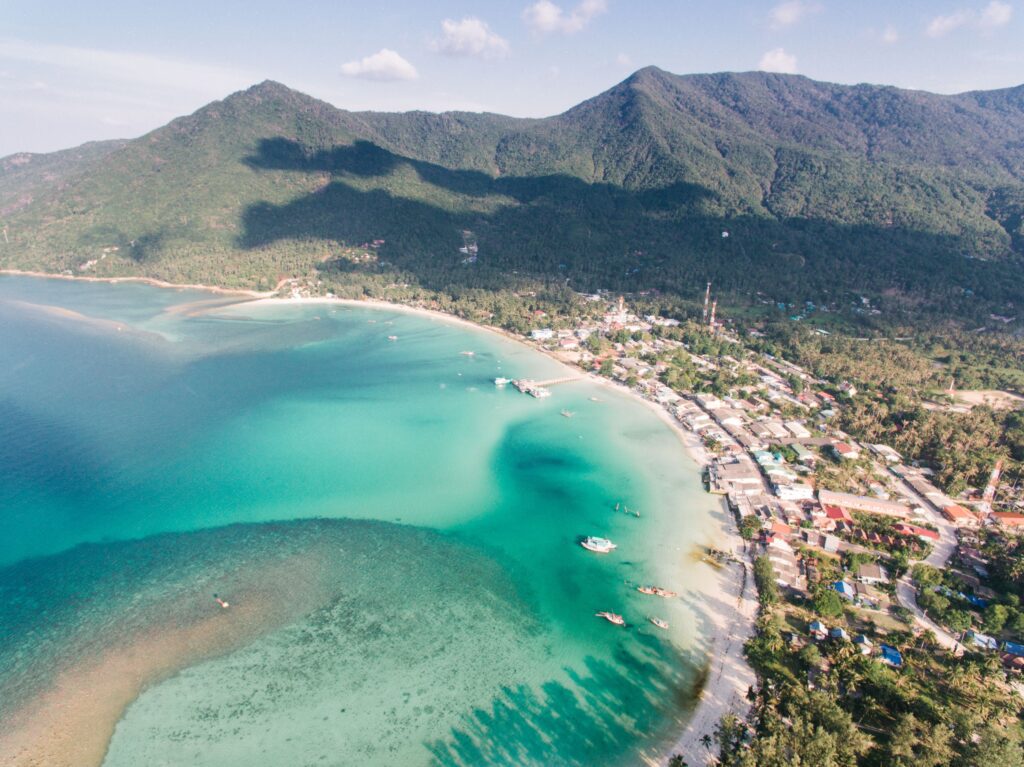
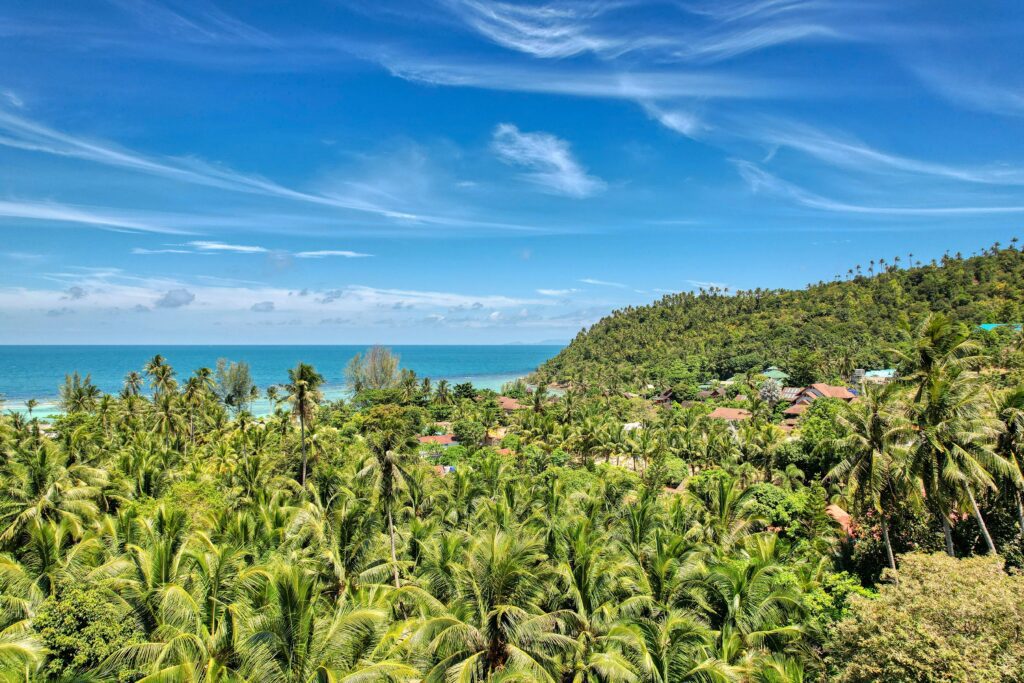
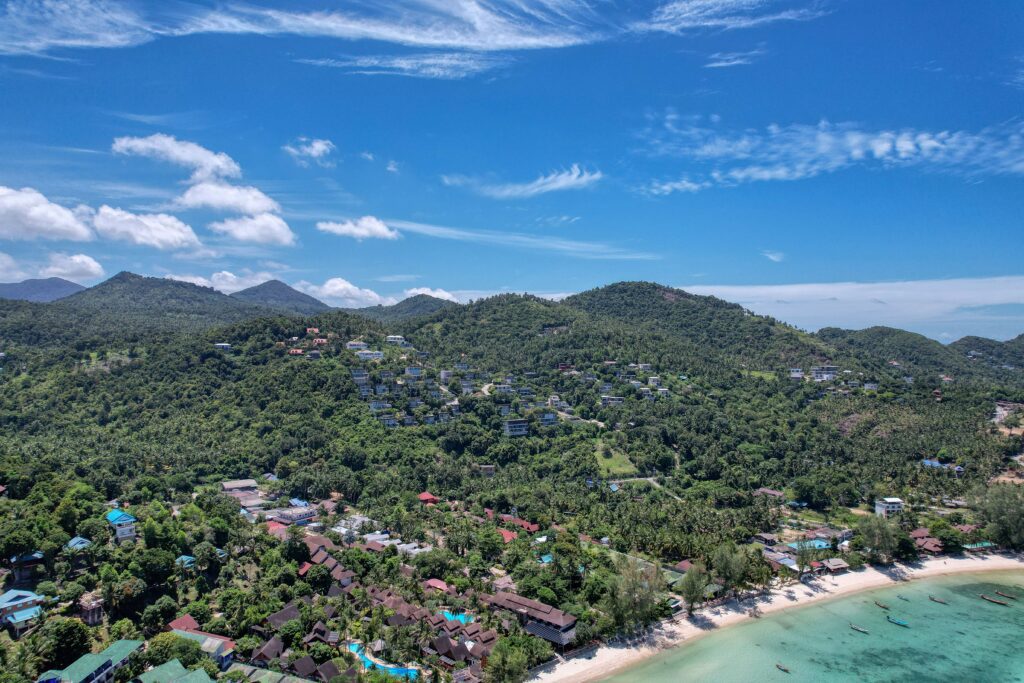
Large parts of the island remain green and mountainous, while the coastline provides beaches, bays and views ranging from the Gulf of Thailand to neighboring islands.
This creates an unusual property market where the physical characteristics of a plot can have an enormous impact on value.
Two plots a short distance apart can have very different values because one may have good road access, a relatively gentle slope, electricity and a usable building site, while the other may require substantial excavation, retaining walls and infrastructure work.
Consequently, Koh Phangan real estate should not be evaluated simply by comparing asking prices per square metre or per rai.
What Types of Koh Phangan Real Estate Are Available?
The island’s property market includes several broad categories, but villas and land are particularly important for buyers searching for a lifestyle property.
Villas and Houses
Private villas are among the most visible properties on Koh Phangan.
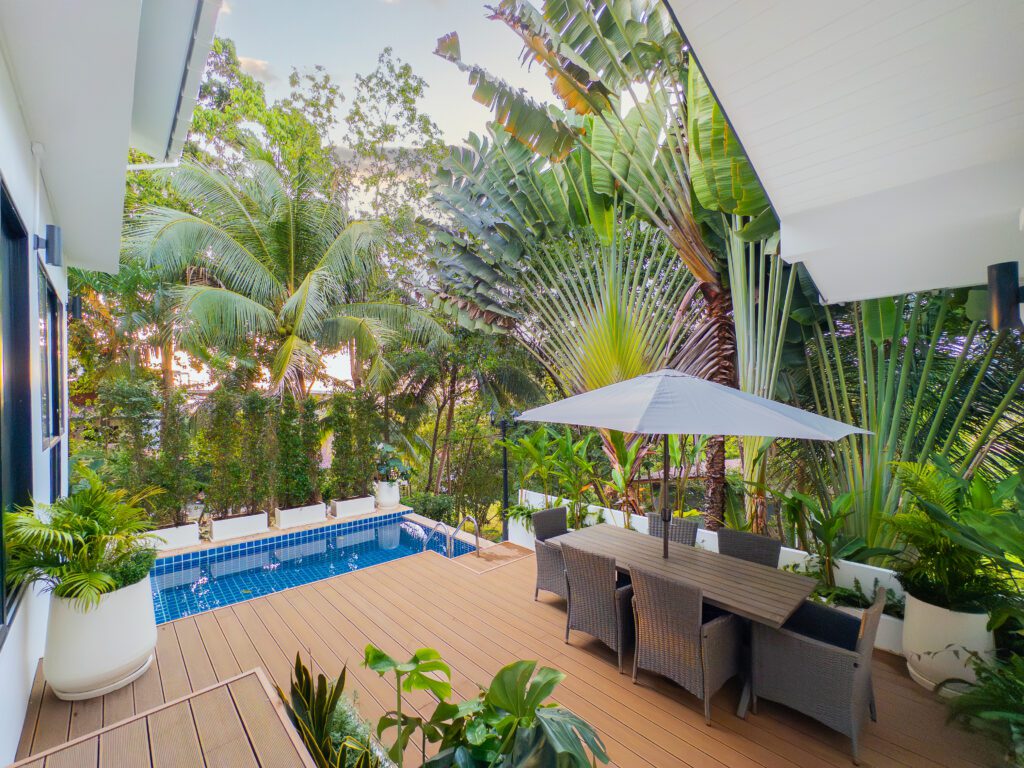
The market ranges from relatively simple homes designed for long-term island living to high-end villas featuring swimming pools, multiple bedrooms, large terraces and panoramic sea views.
The appeal is easy to understand. A private villa can combine the advantages of a holiday home with the potential to generate rental income when the owner is away.
However, foreign buyers need to look beyond the building itself.
In Thailand, ownership of a villa and ownership of the land beneath that villa are not necessarily the same thing.
A foreign purchaser may acquire ownership of a building while obtaining a separate legal right to use the underlying land. Leasehold is one common structure, while other property rights may be appropriate depending on the circumstances.
This means a buyer should never assume that the phrase “foreign-owned villa” means that the foreigner owns the land.
The precise legal structure needs to be established before signing the purchase agreement.
Buying Land on Koh Phangan
Land is an important part of the Koh Phangan real estate market, particularly for buyers who want to build their own villa or develop a larger project.
Land can offer something that a completed villa cannot: control over the design and development of the property.
But land also creates additional risks.
A plot may have a beautiful view and appear inexpensive, yet its real development cost can be much higher once the buyer considers road construction, electricity, water, drainage, foundations, retaining walls and other infrastructure.
The first question is also legal rather than physical:
What type of title does the land have, and can the buyer legally acquire the interest they want?
For foreign buyers, direct ownership of Thai land is generally prohibited, subject to narrow statutory exceptions. Thailand’s official guidance describes an exception for qualifying foreign purchasers involving at least 40 million baht of investment, residential use, a maximum area of one rai and permission from the Minister of Interior. This is not the normal route used by foreign buyers purchasing Koh Phangan villas or land.
For most foreign buyers, land-based property therefore needs to be structured through legally recognized alternatives.
Condominiums and Apartment-Style Property
Condominiums can be attractive because they provide a potential route to direct foreign freehold ownership.
Under Thailand’s Condominium Act, eligible foreigners can own condominium units in a registered condominium building, subject to the foreign ownership quota. Thailand’s government states that foreign ownership may not exceed 49% of the total space of the condominium units in the building.
However, buyers should make an important distinction between a legally registered condominium and a property that is merely marketed using terms such as “condo,” “residence” or “apartment.”
The legal status of the project matters.
Before purchasing a condominium, a foreign buyer should establish that the development is actually registered as a condominium and that the specific unit can be transferred into foreign freehold ownership.
The condominium’s juristic person should also provide confirmation of the foreign ownership proportion. Thailand’s official guidance identifies this confirmation as part of the transfer process.

Where Are the Best Areas for Koh Phangan Real Estate?
There is no single best area on Koh Phangan.
The right location depends heavily on whether you want:
- A holiday home
- A permanent residence
- Rental income
- A development site
- A quiet retreat
- Beach access
- Restaurants and nightlife
- A sea-view villa
Here are some of the main areas worth understanding.
Thong Sala: The Practical Base
Thong Sala is the main commercial and transport center of Koh Phangan.
For someone visiting the island for a holiday, it may not immediately appear to be the most desirable location. For someone living on Koh Phangan year-round, however, its practical advantages become much more obvious.
The area provides access to markets, shops, restaurants, services, the main ferry connections and other everyday facilities.
This makes Thong Sala particularly relevant for buyers who intend to live on Koh Phangan rather than simply visit for short periods.
Property here can also appeal to buyers who prioritize convenience over panoramic sea views.
A villa in a spectacular but remote hillside location may be more attractive in photographs, but a property closer to everyday infrastructure can be more practical for long-term living and easier to manage.
Baan Tai: Tourism and Rental Potential
Baan Tai stretches along the south coast between Thong Sala and Haad Rin and has a strong connection with tourism.
Its proximity to the Full Moon Party destination, restaurants, beach businesses and tourist accommodation gives it a different investment profile from the quieter western and northern parts of the island.
Baan Tai can therefore attract buyers interested in holiday accommodation and rental properties.
However, tourism-driven property should be evaluated carefully.
A property may perform very well during peak periods while producing substantially lower occupancy at other times. Buyers should therefore avoid calculating returns from the highest advertised nightly rate and instead model realistic annual occupancy, operating costs and management expenses.
The area can also suit buyers who want a balance between access to tourist activity and proximity to Thong Sala.
Haad Rin: A Tourism-Focused Property Market
Haad Rin is internationally associated with the Full Moon Party and remains one of Koh Phangan’s most tourism-oriented areas.
That reputation has a major influence on its property market.
For an investor, the concentration of tourism can create opportunities for accommodation and hospitality businesses. For a lifestyle buyer looking for peace and quiet, however, the same characteristics may make the location less suitable.
The important lesson is that property value depends partly on what the buyer wants the property to do.
A location that is highly attractive for holiday accommodation is not automatically the best location for a family home or retirement property.
Sri Thanu: Wellness, International Community and West-Coast Living
Sri Thanu has developed a distinctive identity within Koh Phangan.
The area is closely associated with yoga, wellness, health-focused businesses, cafés, restaurants and an international community. This has created a property market with a strong lifestyle component.
For buyers seeking a home rather than a purely tourism-driven investment, Sri Thanu can be particularly attractive.
The west-coast location also provides access to sunset views and a collection of beaches and coastal communities.
The important point for buyers is that Sri Thanu should not be evaluated solely on tourist rental potential. The area’s appeal comes partly from its residential and lifestyle ecosystem.
A property that works well for a long-term international resident may have different economics from a villa designed around short-term holiday guests.
Hin Kong: Sunset Views and Residential Appeal
Hin Kong is another popular west-coast location.
Its combination of sunset views, restaurants and residential development makes it attractive to buyers who want an accessible lifestyle property without being directly in one of the island’s busiest tourist centers.
Sea-view properties in this part of Koh Phangan can command significant premiums, but buyers should investigate whether the view is actually protected.
A sea view is not automatically permanent.
Land between the property and the sea may be developed in the future, and a buyer should understand the surrounding land ownership and development potential before paying a substantial premium for a view.
Haad Yao: Beach Lifestyle
Haad Yao is one of the better-known beaches on the west side of Koh Phangan and has a mixture of accommodation, restaurants, residences and holiday properties.
It can suit buyers looking for a classic tropical-island lifestyle while retaining access to a developed tourist area.
The surrounding hills also mean that property buyers need to pay attention to the physical characteristics of individual plots.
For hillside properties, road access, drainage, slope stability and construction costs can be just as important as the view.
Chaloklum: A Quieter Northern Alternative
Chaloklum has a different atmosphere from the southern tourist centers.
The area retains a stronger connection with traditional fishing and local island life, while also attracting visitors and residents looking for a quieter location.
For property buyers, this can make Chaloklum appealing for a private home or longer-term residence.
It may be less suitable for someone whose investment strategy depends entirely on the highest possible level of tourist activity.
As elsewhere on Koh Phangan, the right choice depends on the intended use of the property.

Can Foreigners Buy Property on Koh Phangan?
Yes, foreigners can buy certain types of property on Koh Phangan, but they cannot generally own Thai land directly in their own name.
This distinction is fundamental.
A qualifying foreign buyer can own a condominium unit under the foreign ownership provisions of Thailand’s Condominium Act. The foreign ownership limit is generally 49% of the total condominium unit space in the building.
Land is different.
Thailand generally restricts foreigners from owning land directly. There is a narrow statutory exception involving substantial investment and government approval, but this is not the standard mechanism used for Koh Phangan villa purchases.
For a foreign buyer considering a villa, the question therefore becomes:
What legal rights can I acquire over the building and land?
That may involve a registered lease or another appropriate legal structure.
The answer should be determined for the specific property by an independent Thai property lawyer.

How Does Leasehold Work on Koh Phangan?
Leasehold is one of the most common concepts encountered by foreigners looking at Thai villas.
The basic arrangement is straightforward: the foreign buyer does not own the land but receives the contractual right to use it for an agreed period.
Thai government guidance describes long-term leases with a maximum initial term of 30 years and the possibility of renewal, subject to the lessor’s consent and the applicable legal framework.
This is where buyers need to be particularly careful about marketing language.
A property may be advertised as:
“30 + 30 + 30 years.”
That wording should not automatically be interpreted as the equivalent of a guaranteed 90-year ownership right.
The buyer needs to examine the actual lease and understand what is registered, what is contractual, what requires future consent and what happens at the end of the initial term.
Leasehold itself is not necessarily a problem. It is a legal structure used in Thailand.
The problem arises when buyers misunderstand the nature or duration of their rights.

Can a Foreigner Own a Villa on Koh Phangan?
A foreigner can potentially own the building or villa while not owning the land beneath it.
This is one of the most important concepts for anyone searching for Koh Phangan real estate.
Imagine a villa standing on a plot of land.
There can be separate legal interests in:
The land
The building
The right to use the land
A foreign buyer may be able to acquire the building and a registered right to use the land without becoming the owner of the land itself.
The exact structure depends on the transaction.
This is why buyers should ask the seller:
“What exactly will be registered in my name?”
That question is much more useful than simply asking whether a property is “foreigner friendly.”

What About Thai Companies and Foreign Property Buyers?
Foreign buyers may encounter property structures involving Thai companies.
This area deserves considerable caution.
A corporate structure should not be used simply as a nominee arrangement to disguise foreign ownership of land.
The fact that a salesperson says “everyone does it” does not make a structure legally safe.
A buyer considering any company structure should have an independent Thai lawyer examine the company, shareholders, control arrangements and intended transaction.
For most buyers, the goal should be a structure that is transparent, lawful and appropriate to the actual purpose of the purchase.

What Land Titles Should Buyers Look for on Koh Phangan?
Land title is one of the most important elements of Koh Phangan real estate due diligence.
A Chanote, formally Nor Sor 4 Jor, is generally considered the strongest form of land title in Thailand.
But buyers should avoid reducing due diligence to one question:
“Does it have a Chanote?”
A title document needs to be examined in context.
The buyer should establish who owns the land, whether mortgages or other encumbrances are registered, whether boundaries correspond with the property being sold and whether access and other rights are properly documented.
The title is the beginning of the investigation, not the end.

Why Legal Access Matters So Much on Koh Phangan
Access is one of the most underestimated issues in Koh Phangan real estate.
A property can appear to have a road leading directly to it, but physical access and legal access are not necessarily the same thing.
This becomes especially important with hillside properties.
Before buying land or a villa, establish:
- How the property is accessed
- Who owns the access road
- Whether a registered right of way exists
- Whether vehicles can reach the property
- Whether the road is usable throughout the year
- Who is responsible for maintenance
A property with excellent views but uncertain access can become extremely difficult to develop, sell or manage.

Why Koh Phangan Hillside Property Requires Extra Due Diligence
The island’s mountainous terrain is one of its attractions, but it is also one of its biggest development challenges.
Hillside land can involve substantial engineering work.
Depending on the property, construction may require:
- Retaining walls
- Excavation
- Foundations adapted to the slope
- Drainage systems
- Improved access roads
- Utility infrastructure
- Specialized construction methods
These costs can dramatically change the economics of a land purchase.
A plot that looks cheap compared with flatter land may ultimately be more expensive to develop.
For this reason, buyers intending to build should obtain a technical assessment before committing to the land.

Buying a Sea-View Villa on Koh Phangan
Sea-view villas are among the most desirable properties on the island.
The combination of tropical surroundings, privacy and ocean views can make them attractive both as lifestyle properties and holiday rentals.
But the view itself requires due diligence.
Ask:
Who owns the land between the villa and the sea?
Can that land be developed?
Are there restrictions on future construction?
Is the current view dependent on undeveloped land?
Could a neighboring building block the view?
This is especially important when the view represents a significant part of the property’s asking price.
A buyer is not simply buying today’s view. They are buying the property’s legal and physical position within its surrounding environment.
Is Koh Phangan Real Estate a Good Investment?
Koh Phangan real estate can be a good investment, but it should not be treated as a guaranteed appreciation story.
The island has several characteristics that can support property demand, including tourism, international residents, lifestyle demand and limited land availability in desirable locations.
However, the investment case varies substantially between properties.
A luxury villa with a strong location, good access, professional management and realistic rental economics is a very different investment from an undeveloped hillside plot purchased purely because the asking price appears low.
The most useful approach is to evaluate the property based on its actual economics.

How Should You Calculate Rental Returns?
Suppose a villa generates substantial gross rental revenue.
That number alone does not tell you whether the property is a good investment.
You need to subtract:
- Property management
- Cleaning
- Pool maintenance
- Gardening
- Utilities
- Repairs
- Insurance
- Marketing
- Booking platform costs
- Taxes
- Replacement furniture
- Periods without guests
The result is much closer to the property’s true operating income.
Buyers should also distinguish between gross yield and net yield.
If a property is advertised with an attractive gross yield, ask what assumptions were used to calculate it.
Was the calculation based on:
- Peak-season rates?
- 100% occupancy?
- Before management fees?
- Before maintenance?
- Before taxes?
A realistic investment analysis should be based on conservative assumptions rather than the best possible scenario.

Can You Rent Out Koh Phangan Property?
Potentially, yes, but the intended rental model needs to be checked before buying.
This is particularly important for buyers planning short-term holiday accommodation.
Owning a villa does not automatically mean that it can be operated as a hotel or unrestricted short-stay accommodation.
The buyer should investigate the applicable Thai accommodation rules, licensing requirements, property rules and tax obligations.
This matters because rental assumptions can have a significant impact on the property’s valuation.
If the investment only makes sense when the property can legally be rented to short-term guests at a particular rate, confirm that rental model before buying.
Do not buy first and investigate the legality of the rental strategy later.Buying Off-Plan Property on Koh Phangan
Off-plan developments can be attractive because buyers may be able to purchase new properties before construction is completed.
However, an off-plan purchase involves risks that do not exist to the same extent with a completed property.
The buyer needs to investigate both the developer and the project.
Important questions include:
Who owns the land?
What approvals have been obtained?
What exactly is being sold?
What is the completion timetable?
What happens if construction is delayed?
What happens if the finished property differs from the specification?
How is the buyer’s ownership or leasehold interest created?
What happens if the project does not proceed?
The sales brochure is not a substitute for the legal documents.

New-Build vs Resale Koh Phangan Property
There are good reasons to consider both.
A new development may offer modern architecture, new facilities, contemporary finishes and a payment schedule that spreads the purchase price over the construction period.
The downside is uncertainty. The property does not yet exist in its final form, construction can be delayed and the finished development may not perform exactly as projected.
A resale property provides the advantage of being able to inspect what you are actually buying.
You can assess the building, road access, neighborhood, views, landscaping and infrastructure rather than relying on plans and renderings.
However, an older property may require renovation or have maintenance issues.
The best choice depends on the buyer’s priorities and risk tolerance.
Land can provide development potential, but title, access, slope and planning issues become particularly important.

How Much Does Koh Phangan Real Estate Cost?
There is no single average price that accurately describes the Koh Phangan real estate market.
Property prices vary according to a combination of factors including:
Location
Land size
Building size
Sea view
Beach proximity
Access
Land title
Construction quality
Pool
Privacy
Rental potential
Development potential
Ownership structure
This is why two villas with similar floor areas can have dramatically different asking prices.
A villa on a steep plot with difficult access should not necessarily be compared with a similar-sized villa on a flat, easily accessible site.
Likewise, a property with a clear and straightforward ownership structure should not automatically be compared with one where the buyer’s rights are more complicated.
When researching Koh Phangan property prices, compare like with like.
What Makes a Koh Phangan Property More Valuable?
Location is important, but it is only one part of the equation.
A desirable property often combines several characteristics.
A sea view can increase appeal, but a sea view with good road access is more useful than a sea view that requires difficult construction.
Beach proximity can be valuable, but proximity to restaurants, shops and services may matter more to a long-term resident.
A large plot can provide privacy, but only if the land can be legally and practically developed.
A villa with strong rental potential may be valuable, but only if the intended rental strategy is permitted and operating costs are manageable.
The strongest properties therefore tend to be those where several desirable characteristics overlap.

The Koh Phangan Property Buying Process
Buying property on Koh Phangan should be approached as a process rather than a single transaction.
1. Decide what you are trying to achieve
Before looking at properties, decide whether you want a permanent home, holiday residence, rental investment, development opportunity or a combination of these.
This will immediately narrow down the appropriate locations and property types.
2. Set a realistic total budget
Do not use the advertised property price as your complete budget.
Allow for legal fees, government charges, due diligence, renovation, furnishing and ongoing ownership costs.
For land, also consider the cost of making the property developable.
3. Research the locations
Spend time in different parts of Koh Phangan.
A location that looks perfect on a property website may feel completely different once you experience its roads, traffic, restaurants, noise levels and distance from essential services.
4. Shortlist properties
Once you know which area suits your objectives, compare properties with similar characteristics.
Do not compare only the number of bedrooms.
Look at title, access, land size, building quality, views, infrastructure and ownership structure.
5. Establish what you will legally own
This is particularly important for foreign buyers.
For a condominium, establish whether foreign freehold ownership is available.
For a villa, determine who owns the land and what rights the buyer will acquire over the land and building.
6. Appoint an independent lawyer
Your lawyer should represent your interests.
The lawyer should review the title and ownership structure and investigate the relevant contracts, encumbrances and registration requirements.
7. Carry out technical due diligence
For land and villas, consider a physical inspection of:
- Building condition
- Electrical systems
- Water
- Drainage
- Pool
- Roof
- Foundations
- Retaining walls
- Access roads
This is especially important for hillside property.
8. Negotiate the purchase agreement
The agreement should clearly establish:
- Purchase price
- Deposit
- Completion date
- Included furniture
- Fixtures
- Conditions
- Default provisions
- Transfer responsibilities
- What happens if due diligence identifies a problem
9. Complete the transfer or registration
The final process depends on the property type and ownership structure.
For condominium purchases, foreign ownership quota documentation is part of the transfer process.
For land-based property, the appropriate lease or other property rights need to be properly documented and registered where required.

The Most Important Koh Phangan Real Estate Due Diligence
Due diligence is where a buyer determines whether the attractive property they have found is actually a sound purchase.
Land title and ownership
Confirm who legally owns the land and what title exists.
Do not rely solely on a photocopy provided by a salesperson.
Access
Establish legal and practical access.
This is particularly important for hillside villas and undeveloped plots.
Building legality
If there is already a villa on the land, investigate whether it was legally constructed and whether later additions were properly authorized.
A buyer should not assume that every existing structure on a property has been legally approved.
Utilities
Confirm electricity, water, internet, drainage and wastewater arrangements.
Remote properties can require significantly more infrastructure than buyers initially expect.
Development potential
If you are buying land, establish what you can actually build before calculating the property’s potential value.
A plot is only worth its development potential if that development can legally and practically occur.
Encumbrances
The property should be checked for registered mortgages, liens, easements and other interests.
These can materially affect the buyer’s rights.

Common Mistakes When Buying Koh Phangan Real Estate
Buying because of the view
A great view can be emotionally persuasive, but it should not override legal and technical due diligence.
Assuming a villa includes land ownership
Foreign buyers need to distinguish between the building and the land.
Treating a lease renewal as guaranteed ownership
A future renewal is not necessarily the same as an existing registered property right.
Buying land without checking development costs
The purchase price can be only the beginning of the investment.
Assuming physical access means legal access
Always establish the legal basis for access.
Believing rental projections without checking the assumptions
A high gross rental figure can look very different after expenses and vacancy.
Using nominee structures
Foreign buyers should be particularly cautious about arrangements intended to circumvent Thailand’s foreign land ownership restrictions.
A structure that appears convenient at purchase can create significant problems later.
Is Koh Phangan Better for Lifestyle or Investment?
For many buyers, the answer is both.
This is one of the interesting characteristics of the island’s property market.
A buyer may purchase a villa primarily as a home but rent it when traveling.
Another buyer may view the property primarily as an investment but use it personally for several weeks each year.
The challenge is balancing the two objectives.
A property optimized for personal use may not produce the best rental return.
A property optimized for short-term rental may not be the most enjoyable home.
The best purchase is therefore one where the buyer is clear about which objective takes priority.
Who Is Koh Phangan Real Estate Best Suited To?
Koh Phangan can be particularly attractive to buyers who value nature, tropical living, international communities and a less urbanized environment.
It can suit:
- Second-home buyers
- Long-term residents
- Lifestyle investors
- Villa investors
- Wellness-oriented buyers
- Hospitality entrepreneurs
- Property developers
It may be less suitable for buyers who prioritize a highly liquid property market, extensive urban infrastructure or easy short-term resale.
The island’s relatively specialized market means that the eventual buyer pool for a particular property can be narrower than in a major city.
That should be considered when thinking about resale.

Koh Phangan Real Estate: Questions to Ask Before Buying
Before committing to a property, the buyer should be able to answer several basic questions.
What exactly am I buying?
Who owns the land?
What type of title exists?
Do I have legal access?
What rights will be registered in my name?
Can the property be legally used for my intended purpose?
Can I build what I want to build?
What are the true annual operating costs?
Is the projected rental income realistic?
What happens when I eventually want to sell?
If any of these questions cannot be answered clearly, the purchase deserves further investigation before proceeding.

Frequently Asked Questions About Koh Phangan Real Estate
Is Koh Phangan a good place to buy property?
Koh Phangan can be an attractive place to buy property for lifestyle buyers and investors, but the quality of individual properties varies considerably. Location, legal structure, access, construction quality, rental potential and purchase price all need to be considered together.
Can foreigners buy real estate on Koh Phangan?
Yes. Foreigners can acquire certain types of property and property rights on Koh Phangan. Qualifying condominium units can be owned under Thailand’s foreign freehold rules, while direct foreign ownership of land is generally restricted.
Can foreigners own land on Koh Phangan?
Generally, no. Thai law restricts direct foreign land ownership, subject to limited statutory exceptions involving specific conditions and government approval.
Can foreigners buy a villa on Koh Phangan?
Yes, but owning a villa is not necessarily the same as owning the land beneath it. Foreign buyers may acquire ownership of a building and separately obtain legally recognized rights to use the land.
What is the best area to buy property on Koh Phangan?
It depends on the buyer’s objective. Thong Sala is practical for everyday living, Baan Tai and Haad Rin have stronger tourism connections, Sri Thanu is associated with wellness and international living, while Hin Kong, Haad Yao and Chaloklum offer different combinations of beaches, views and residential character.
Is Koh Phangan real estate a good investment?
It can be, but rental income and capital appreciation should never be assumed. The investment case should be calculated using the actual purchase price, realistic occupancy, operating expenses, management costs and the property’s legal rental position.
Can foreigners own a condominium on Koh Phangan?
Yes, if the property is a qualifying registered condominium and the foreign ownership quota is available. Foreign ownership is generally limited to 49% of the total condominium unit space in the building.
What is leasehold property in Koh Phangan?
Leasehold gives the buyer a contractual right to use land for an agreed period rather than ownership of the land itself. A standard Thai lease is generally structured around a 30-year initial term, with renewal arrangements requiring careful legal review.
Is a 30+30+30 lease the same as owning property for 90 years?
No. Buyers should not automatically treat future renewal provisions as equivalent to a currently registered 90-year property right. The actual lease and applicable law need to be reviewed.
Should I buy land or a finished villa on Koh Phangan?
It depends on your objective. Land can provide greater control over development, but it introduces additional questions around title, access, planning, infrastructure and construction costs. A completed villa allows you to inspect the finished property but may require renovation or ongoing maintenance.
Do I need a lawyer to buy Koh Phangan property?
Independent legal advice is strongly recommended, particularly for foreign buyers, land, villas, leasehold arrangements, off-plan developments and transactions involving corporate structures.
Does buying property on Koh Phangan give a foreigner residency?
No. Property ownership and immigration status are separate matters. Buying a property does not automatically provide permanent residency or the right to remain in Thailand indefinitely.

Final Thoughts on Koh Phangan Real Estate
Koh Phangan real estate offers something increasingly rare in Thailand: a property market where tropical lifestyle, international demand, tourism and relatively low-density development overlap.
But that opportunity comes with complexity.
The most desirable properties are not necessarily the ones with the lowest asking price or the most impressive photographs.
A strong property purchase usually combines:
A good location
A defensible legal structure
Clear title
Reliable access
Practical infrastructure
Good construction
Realistic rental economics
A sensible purchase price
A clear exit strategy
For foreign buyers, the legal structure should be established before the emotional decision to purchase takes over.
For investors, the rental model should be tested against realistic operating costs rather than headline yields.
For land buyers, development feasibility matters as much as the price of the land itself.
And for anyone buying a sea-view property, the surrounding land and future development potential deserve as much attention as the view itself.
Ultimately, the best Koh Phangan real estate purchase is not simply the property that looks best.
It is the property where the location, legal rights, physical characteristics, price and intended use all make sense together.

Koh Phangan Real Estate Buying Checklist
Before committing to a purchase, make sure you have established:
- What exactly you are buying
- Who owns the land
- What type of title exists
- Whether access is legally secured
- What rights will be registered in your name
- Whether the building is legally constructed
- Whether your intended use is permitted
- What utilities are available
- What the total acquisition cost will be
- What the ongoing ownership costs will be
- Whether rental assumptions are realistic
- Whether an independent lawyer has reviewed the transaction
The most important principle is simple:
Do not buy the property until you understand the rights attached to it.
This guide is intended as general information and is not legal, tax or financial advice. Thai property laws, regulations and administrative requirements can change. Foreign buyers should obtain independent advice from a qualified Thai property lawyer before entering into a purchase agreement.